
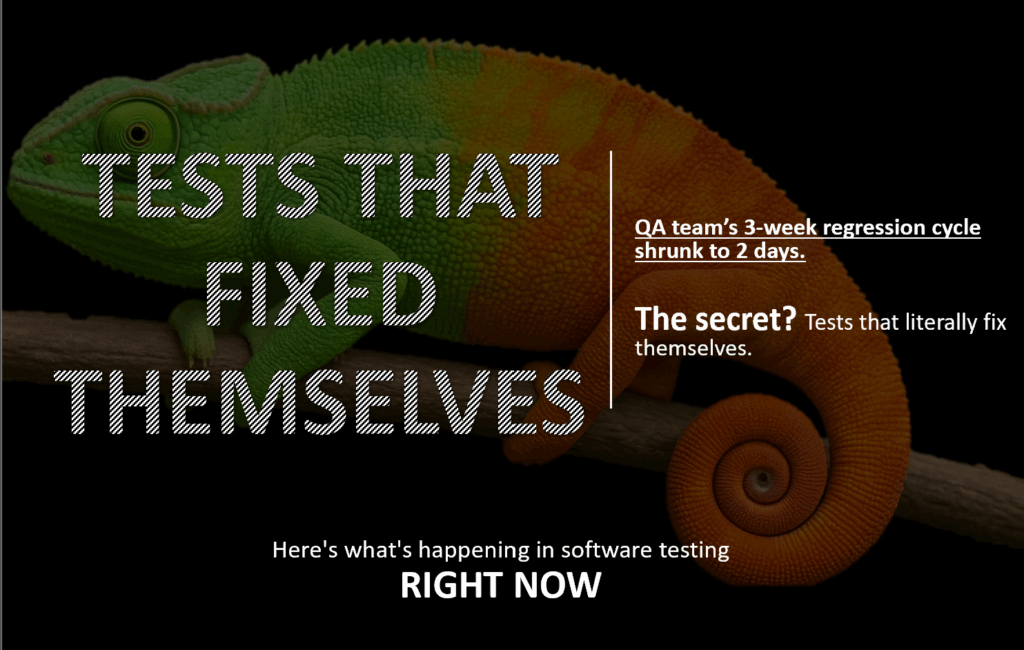
Gone are the days when a single UI change could break 50+ test scripts, leaving teams scrambling for weeks. The testing revolution is here, and it’s transforming everything.
But here’s the reality check:
While some companies ship features 5x faster with higher quality, majority are still manually fixing broken tests and losing millions in delayed releases.
The choice facing QA teams today is crystal clear:
Either continue fighting yesterday’s battles with outdated, brittle tools, or embrace the power of self-healing tests—an intelligent evolution that adapts as fast as the code itself.
This shift isn’t just a technical upgrade; it’s a redefinition of how we approach quality; it’s a mindset shift. Self-healing tests dramatically reduce the noise and maintenance chaos caused by frequent UI changes and minor updates. They empower teams to focus on what truly matters—delivering quality at speed.
Here’s how self-healing test automation is transforming software testing:
Automatic Detection & Repair
- AI identifies broken test elements instantly when they fail
- Automatically updates selectors when UI changes (CSS, XPath, ID modifications)
- Smart element recognition using multiple attributes, not just one fragile locator
- Self-corrects for minor layout shifts, repositioned elements, and styling changes
- Learns from successful repairs to improve future detection accuracy
- Generates detailed repair logs showing exactly what was fixed and why
- No more manual intervention for common UI evolution patterns
The Impact
- 85% reduction in test maintenance overhead
- Test suites stay stable even as applications evolve rapidly
- Teams focus on writing new tests, not fixing old ones
- Reduced “test debt” accumulation that traditionally slows teams down
- Higher test coverage confidence – tests don’t get disabled due to maintenance burden
- Developer productivity increases – fewer interruptions from broken test alerts
- QA engineers become strategic contributors instead of maintenance firefighters
- Test execution reliability improves – fewer false negatives from brittle locators
- Improved team morale
- Reinforced stakeholder confidence
Ripple effects of self-healing tests:
Operational Benefits:
- Faster CI/CD pipelines
- Reduced “test debt”
- Higher test coverage confidence
Team Benefits:
- Developer productivity gains
- QA role transformation from reactive to strategic
- Fewer interruptions and alerts
Technical Benefits:
- Improved test execution reliability
- Fewer false negatives
Real transformation:
A major e-commerce platform went from 2-day regression cycles to deploying 5x per week. By implementing AI-powered self-healing tests, they dramatically reduced maintenance overhead and saw customer satisfaction improved by 40% over 18 months.
The secret? AI-powered self-healing test automation.
This transformation requires upfront investment in time, tooling, and training. It’s a strategic initiative, not a quick fix. Setting up an intelligent testing ecosystem—one that incorporates AI-driven test maintenance, robust object recognition, and seamless CI/CD integration—requires upfront time, tooling, and training. The benefits are real, but they don’t come overnight. The organizations that reap the most rewards are those that treat this as a strategic initiative, not a shortcut.
And importantly, this doesn’t eliminate the role of manual testing – 𝗶𝘁 𝗿𝗲𝗽𝗼𝘀𝗶𝘁𝗶𝗼𝗻𝘀 𝗶𝘁.
Testers are no longer reactive executors waiting on code. They become strategic, proactive innovators—identifying project and organizational needs early, shaping the test architecture, and driving quality from the outset. Manual testing is still critical for exploratory analysis, strategic validation, and ensuring that what we build aligns with both user expectations and business goals.
The intelligent testing revolution is here. It’s not just about tests that fix themselves—it’s about QA professionals evolving into quality leaders, backed by smart tools, guided by insight, and focused on outcomes.
The numbers don’t lie:
- AI testing adoption has increased from 7% in 2023 to 16% in 2025, signaling a growing interest in leveraging AI-driven automation
- 56% of teams are already in the “investigating” phase of AI adoption with 38% seeing AI as a solution for tester shortages
- The global automation testing market is poised to reach $55.2 billion by 2028, growing at a CAGR of 14.5%
- The AI in software testing market is projected to grow by 37.3% from 2023 to 2030
What’s driving this transformation?
Organizations are moving beyond traditional testing approaches because manual test maintenance has become the bottleneck. Companies are motivated to use more AI since 38% see AI as a solution for tester shortages Top Automation Testing Trends to Watch in 2025 | Test Guild, and the results speak for themselves.
The momentum is undeniable.
While we’re still in the early stages—AI testing adoption jumping from 7% to 16% in just two years 30+ Test Automation Statistics In 2025- Testlio —the trajectory is clear. Organizations that embrace AI-powered testing now are positioning themselves for the future of software delivery.
Ready to transform your testing strategy? Let’s talk.
👉 Follow SSS Global IT Solutions for more insights
🔗 Schedule a consultation- Contact Us – SSS Global IT